

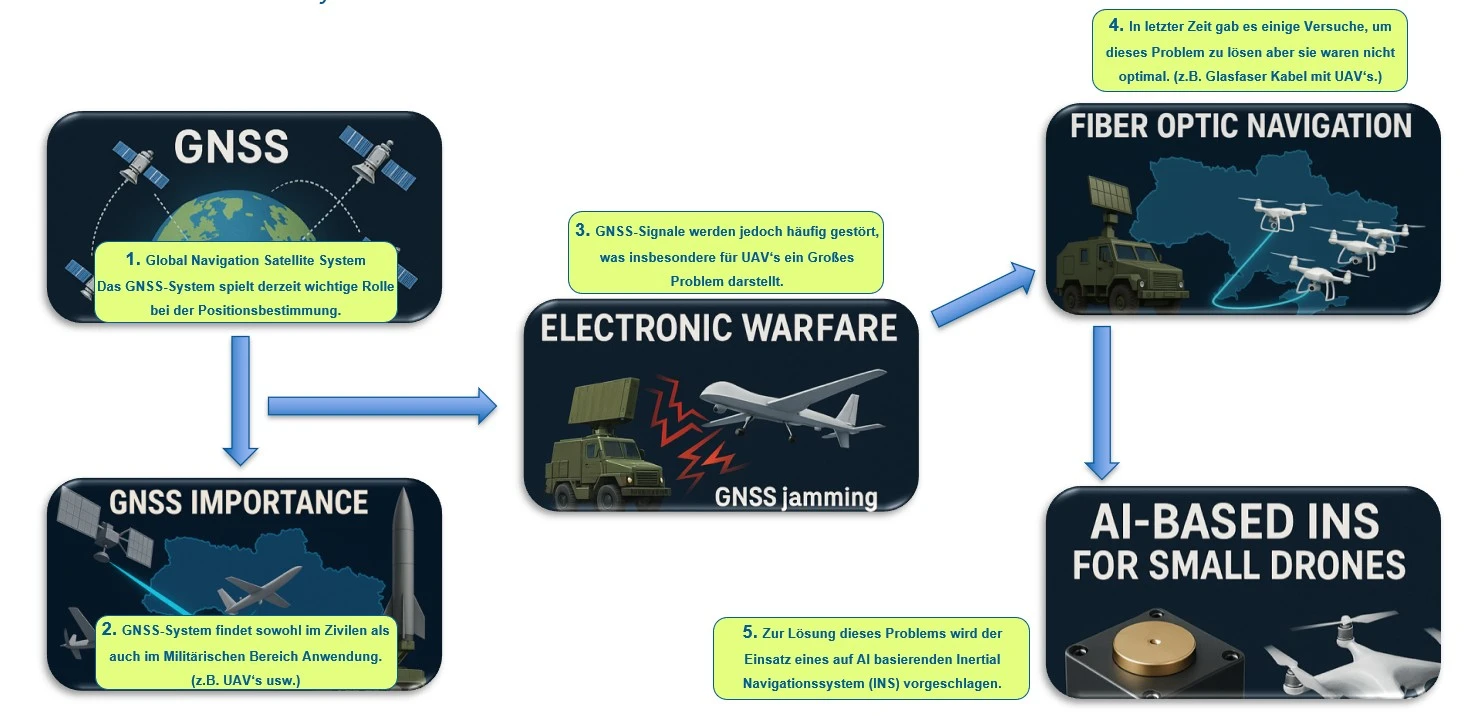
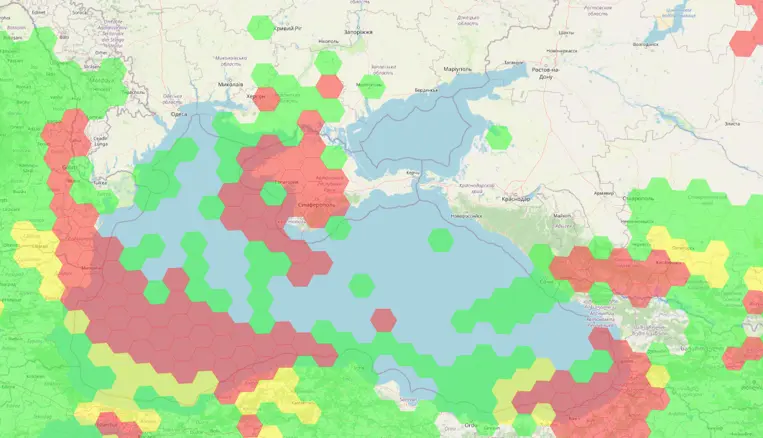
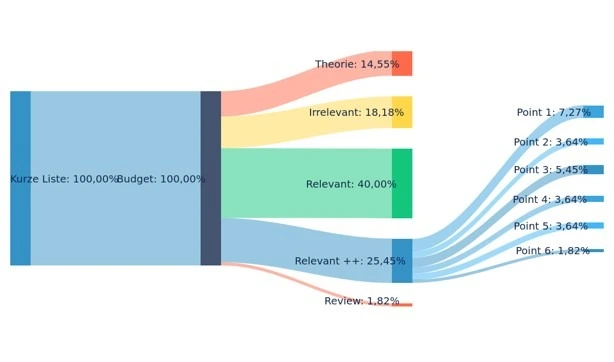
- Using eight key terms, a search was carried out in databases (ACM, CVP), resulting in the examination of 119 articles, of which 55 were selected.
- To identify the 55 most relevant articles, their abstracts were analysed.
- All articles were reviewed against the aforementioned key terms.
- 14 relevant ++ papers
- 1 review paper (Direction Net)
Real-world examples
Literature Optimisation
Research Input
Breakdown of the methods used
AI methods:
- CNN
- CNN + Transformer
- CNN + GNN
- CNN + Transformer + GNN
- Transformer
- Transformer + GNN
Mathematical methods (Mathematical Methods):
- Pixel
- VIO
- ORB-SLAM
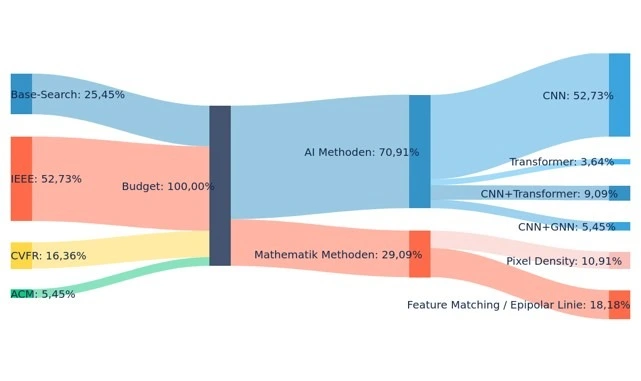
In the chart, a total of 70.91% of the methods are AI methods, whilst the remaining 29.09% are classified as mathematical methods. Among the AI methods, CNN is the most frequently used method at 52.73 per cent, followed by CNN + Transformer (9.09 per cent), CNN + GNN (5.45 per cent) and Transformer (3.64 per cent).
Among the mathematical methods, feature matching / epipolar line is the preferred method at 18.18 per cent, whilst the pixel density method was used in 10.91 per cent of cases.
Looking at the sources of the data, 52.73 per cent of the methods used originate from IEEE, 25.45 per cent from Base-Search, 16.36 per cent from CVFR and 5.45 per cent from ACM.
This information illustrates how various research platforms and methods are distributed within the research community.

Breakdown by area of application
- Wide Base
- Panoramic
- Dynamic / UAV
- Local Pose Estimation
- E2E
- Multi-camera
- RGB-D
Of the Artificial Intelligence methods, CNN was the most frequently used (67.49 %). The preferred application areas for CNNs are, in particular, localisation/pose estimation (15.38 %), wide-base (15.38 %) and panoramic (9.23 %).
The Transformer and CNN + Transformer methods were used in equal proportions (12.50 % each). Academic studies employing these methods focus primarily on the end-to-end (E2E) domain.
The CNN + GNN method was used in 7.51 % of cases and was applied primarily in the areas of localisation/pose estimation (4.61 %) and end-to-end (3.08 %).
This distribution clearly shows the specific areas in which different AI techniques are used effectively.

DirectionNet
DirectionNet-R & DirectionNet-T
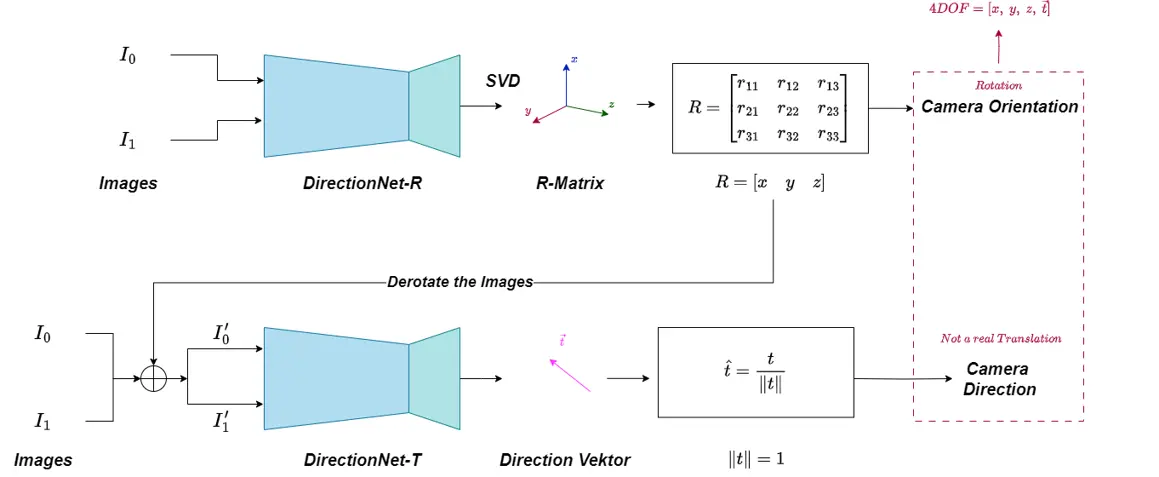
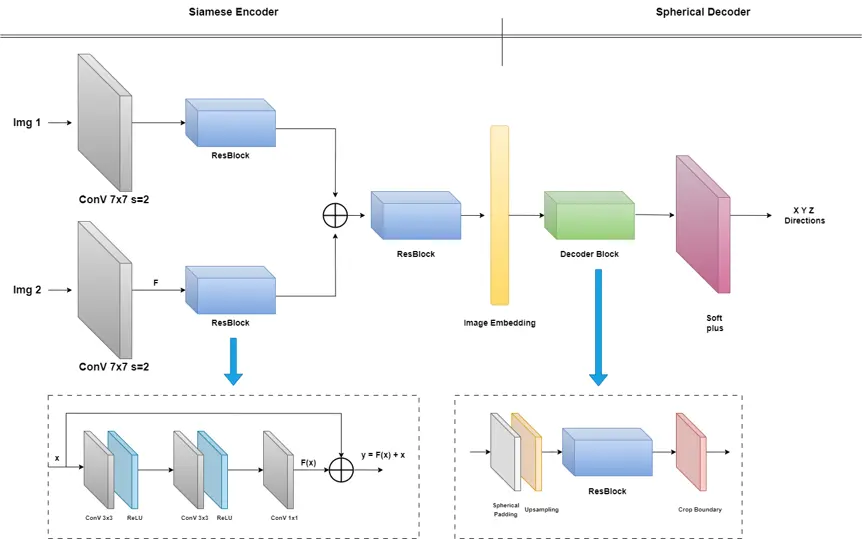
The ‘DirectionNet’ structure is divided into two parts: DirectionNet-R and DirectionNet-T. This structure is used to determine the camera rotation (orientation) and the camera direction.
DirectionNet-R:
In this part, two input images (I₀ and I₁) are fed into a neural network called DirectionNet-R. A rotation matrix (R-matrix) is then calculated using the method of singular value decomposition (SVD). This matrix is used to determine the camera rotation. The result is a set of values with four degrees of freedom (4DOF) [x, y, z, ṫ].
DirectionNet-T:
In this section, the previously calculated R-matrix is first used to correct the rotation of the images (derotation). The corrected images (I₀' and I₁') are then fed into the DirectionNet-T neural network. A normalised direction vector is obtained from this network, which describes the camera direction. Although this vector does not represent a true translation, it is used to determine the camera’s line of sight.
In summary, the DirectionNet structure combines two different network architectures to precisely determine the camera’s rotation and direction from image data.
Why Edge AI
Running a wide-baseline relative-pose network is compute-intensive — yet a drone that has just lost GNSS is exactly where cloud inference breaks down: the uplink may be jammed, unavailable or too slow, and offloading perception to a server adds latency a flight controller cannot tolerate. The answer is Edge AI: executing the trained model directly on the aircraft, at the point where the images are captured. Bringing the intelligence to the sensor — instead of the sensor data to a server — delivers:
- Deterministic, low latency — perception and pose estimation run in a fixed time budget, inside the control loop
- Full autonomy — no dependence on connectivity, cloud or ground station
- Energy- and weight-efficiency — the entire inference pipeline fits the power envelope of a small UAV
- Data stays on the drone — nothing has to be streamed off the platform to be understood
To meet this edge-AI requirement, our group designed and built a dedicated on-board compute platform in-house — the bridge between our DirectionNet / E2ENet models and real flight in GNSS-denied airspace.
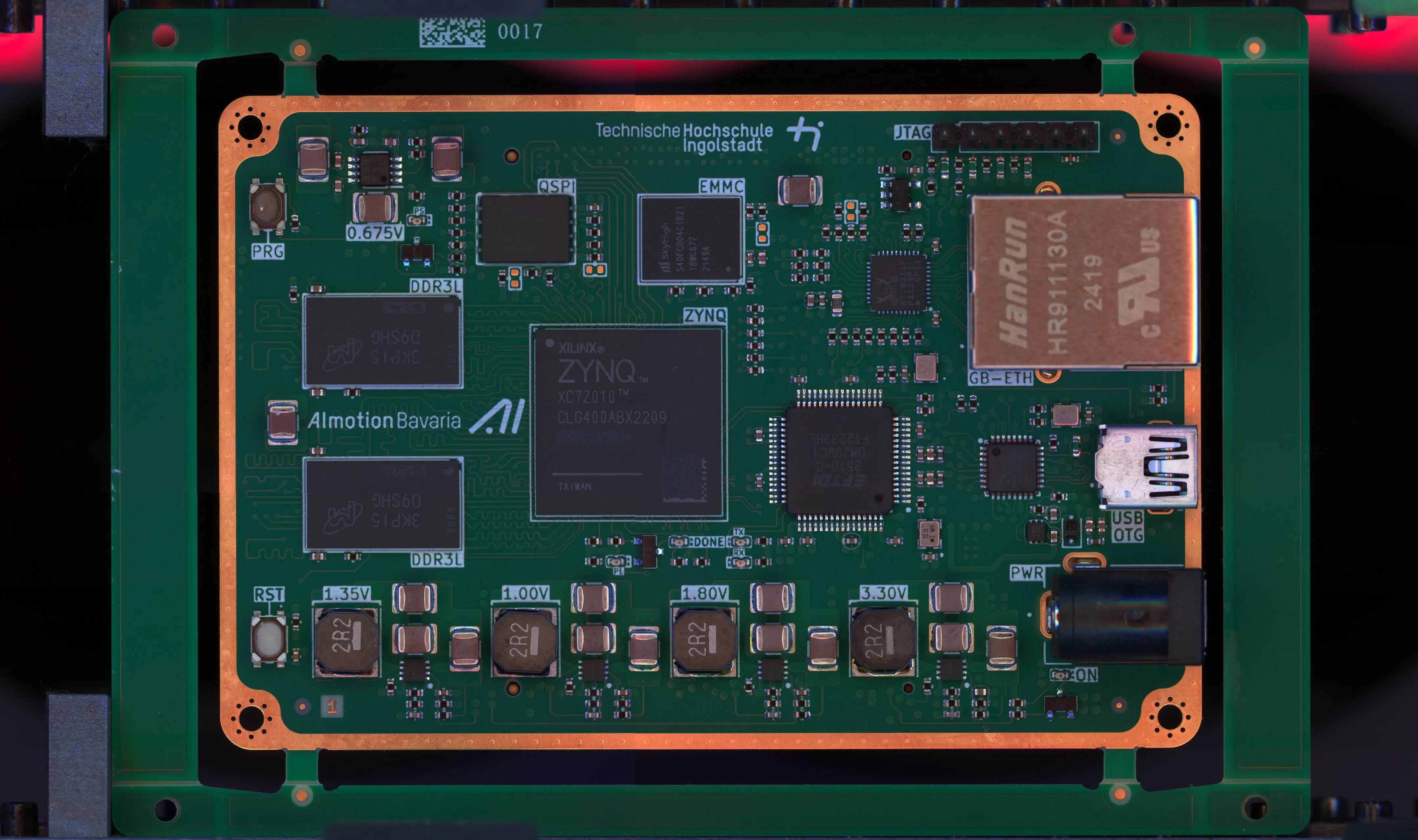
A custom Edge-AI system-on-module
The platform is a compact system-on-module built around an AMD/Xilinx Zynq-7010 (XC7Z010) — a heterogeneous SoC that pairs a dual-core ARM Cortex-A9 with FPGA programmable logic on a single, low-power device. The ARM cores run a full embedded Linux stack and the high-level localisation software, while the FPGA fabric provides hardware acceleration for the AI model itself (detailed below). The result is real-time, on-device inference — no external computer, no ground station.
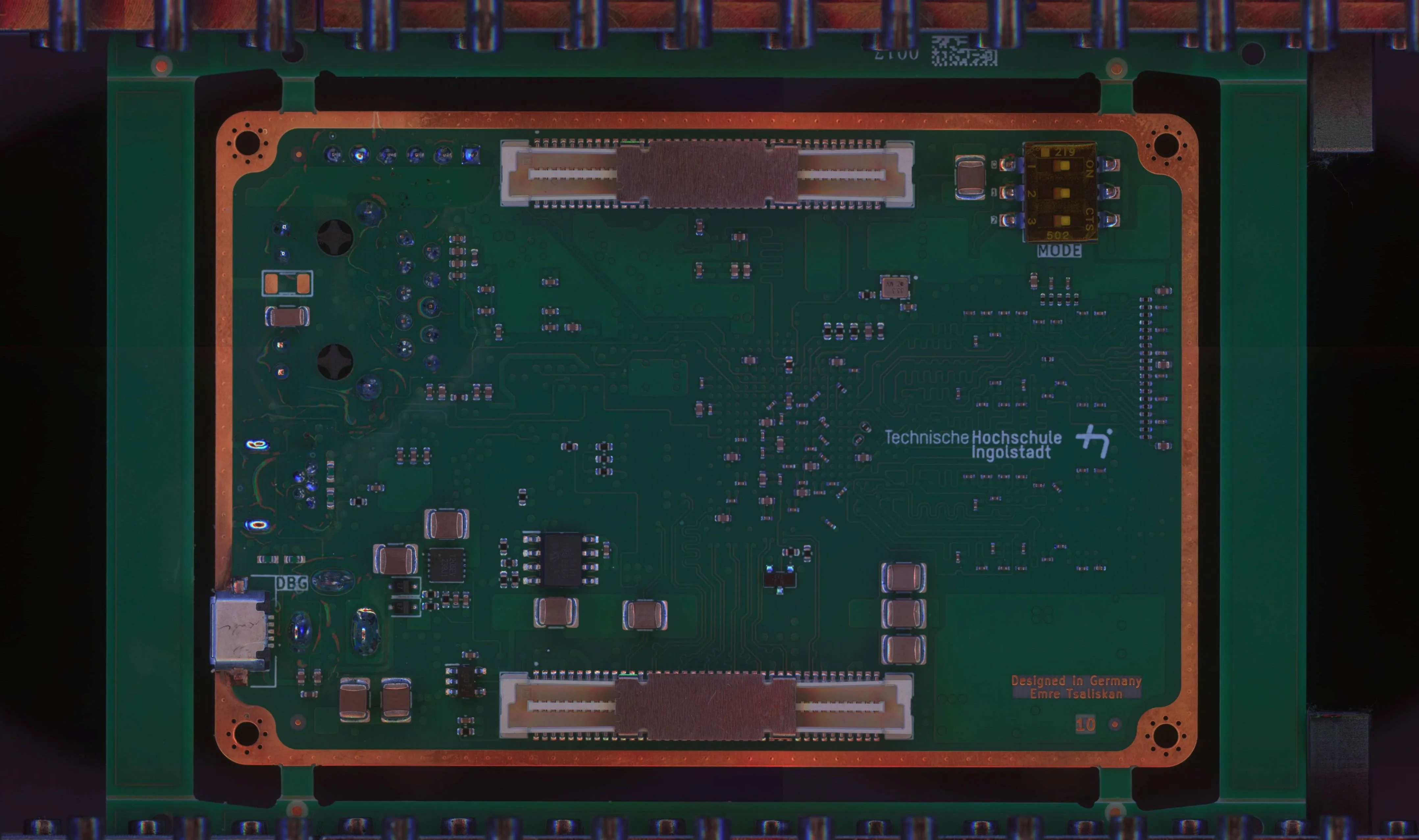
Everything needed for autonomous, self-contained operation is integrated onto one board that mates to any drone carrier through its board-to-board connectors:
- AMD/Xilinx Zynq-7010 SoC — dual-core ARM Cortex-A9 (PS) + FPGA fabric (PL) for on-device AI acceleration
- 1 GB DDR3L memory, 16 MB QSPI and 4 GB eMMC for fully standalone boot
- Gigabit Ethernet, USB 2.0 (ULPI) and integrated UART/JTAG debug (FTDI)
- On-board DC/DC supplies generating all rails (+3V3, +1V8, +1V35, +1V0) from a single input
- Compact SoM form factor with dual mezzanine connectors — designed, routed and validated in-house at THI (hardware design: Emre Tsaliskan)
Designing the platform ourselves means the compute, the sensors and the edge-AI models are developed as one integrated system, rather than being forced to fit off-the-shelf constraints.
FPGA-based AI hardware acceleration
What makes real-time inference possible within a drone's power budget is hardware acceleration in the FPGA fabric. Rather than relying on the ARM cores alone, the compute-intensive parts of the perception network are mapped directly onto the Zynq's programmable logic, where they execute as dedicated, massively parallel hardware. This gives the platform:
- Deterministic, real-time inference — a fixed, predictable latency, in the control loop
- High throughput-per-watt — far more efficient than a CPU-only solution
- A datapath tailored to the model — custom precision, quantisation and pipelining
In effect, the FPGA turns the module from a general-purpose computer into a purpose-built AI accelerator sized for a small UAV — the hardware foundation of the whole edge-AI approach.
Onboard deployment
For flight, the module is integrated into a compact, in-house sensor pod with an onboard monocular camera and LiDAR — the deployable, flight-ready form of the platform.
All perception and localisation run entirely on the module inside the pod.
From research to real GNSS-denied flight
Together with our DirectionNet / E2ENet models, the in-house module brings wide-baseline relative-pose estimation out of the dataset and onto the aircraft — running as edge AI, accelerated in the FPGA, in real time, precisely in the jammed and GNSS-denied environments that motivate this work.
Research Gaps
Performance improvement with low image similarity:
There is a need for methods that can improve system performance even when there is low correspondence (similarity) between images. This area highlights the need to develop new techniques that enable more robust information extraction from different images.
Reducing the influence of dynamic objects using transformers and GNNs:
Transformer models can learn time-varying objects from the image data and reduce their influence on the results. Graph Neural Networks (GNNs), in turn, convert objects in the images into graph-based structures, thereby facilitating processing by Transformer blocks. This method allows the relationships between objects to be modelled more clearly and effectively.
Energy-efficient systems for real-time processing and small UAVs:
Systems with low energy consumption and real-time processing should be developed in such a way that they can be integrated directly into various systems without the need for complex hardware components (e.g. FPGAs). This enables effective and efficient use on energy-constrained platforms such as small unmanned aerial vehicles (UAVs).
These research gaps define critical areas for future academic studies and offer significant opportunities in terms of technological developments and practical applications.

Special Embedded Hardware Modul
GNSS-Denied Navigation-Drone Module

Sources
- K. Chen, N. Snavely and A. Makadia, "Wide-Baseline Relative Camera Pose Estimation with Directional Learning," 2021 IEEE/CVF Conference on Computer Vision and Pattern Recognition (CVPR), Nashville, TN, USA, 2021, pp. 3257–3267, doi: 10.1109/CVPR46437.2021.00327.
- Rockwell, Chris; Kulkarni, Nilesh; Jin, Linyi; Park, Jeong Joon; Johnson, Justin; and Fouhey, David F. “FAR: Flexible, Accurate and Robust 6DoF Relative Camera Pose Estimation”, 2024, arxiv.org/abs/2403.03221
- Jianyuan Wang, Minghao Chen, Nikita Karaev, Andrea Vedaldi, Christian Rupprecht and David Novotny, “VGGT: Visual Geometry Grounded Transformer”, 2025, arxiv.org/abs/2503.11651



![[Translate to English:] Logo Akkreditierungsrat: Systemakkreditiert](/fileadmin/_processed_/2/8/csm_AR-Siegel_Systemakkreditierung_bc4ea3377d.webp)