
At AImotion Bavaria, the Computer Vision for Intelligent Mobility Systems research group explores how reinforcement learning can be made robust and trustworthy for autonomous mobility.
Building on our expertise in computer vision and sensor-based perception, we design learning agents that remain stable under uncertainty, sensor noise, and adversarial conditions.
By integrating robustness into every stage, from perception to decision-making, we aim to enable AI systems that act safely and reliably in complex real-world traffic environments.
Overview
Objectives
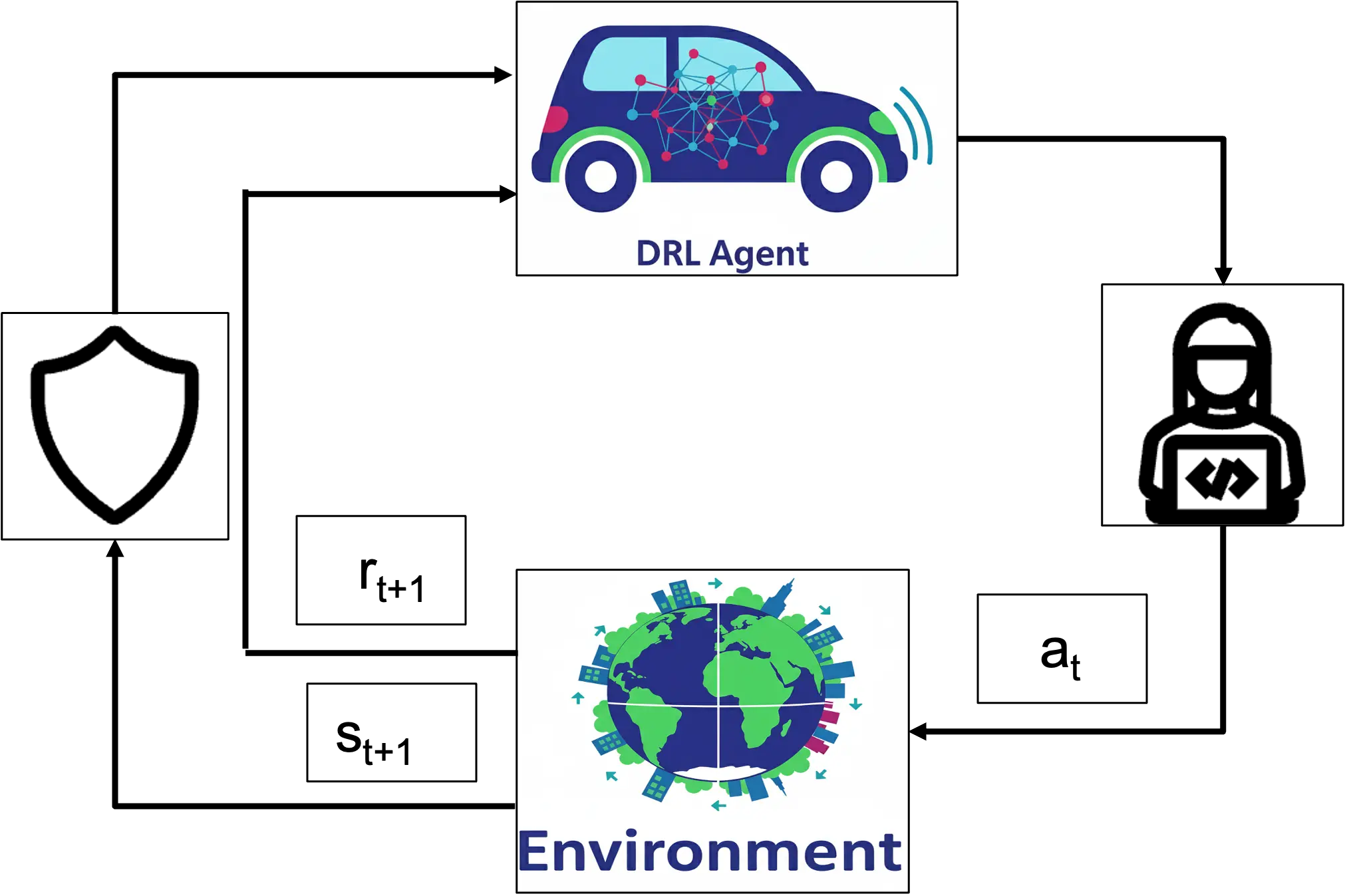
Investigating how adversarial attacks affect deep reinforcement learning models for autonomous systems. Developing ensemble defense strategies that improve resilience against diverse attack types. Framing robustness as an integrated concept, combining safety and security aspects of AI models. Contributing to safe and trustworthy deployment of reinforcement learning methods in real-world driving scenarios.
Methodology
- Adversarial Analysis – systematic evaluation of how attacks influence deep reinforcement learning models.
- Defense Mechanisms – design and testing of ensemble defense approaches that combine multiple countermeasures.
- Robustness Evaluation – benchmarking model resilience in simulated and controlled real-world-like environments to ensure safety and reliability.
Selected Research Results
Our research on robust reinforcement learning focuses on understanding how intelligent agents behave under uncertainty and adversarial influence, and how these vulnerabilities can be addressed without compromising policy efficiency or deployment feasibility. The following lines of work highlight key scientific insights emerging from our recent studies.
Improving Robustness with Ensemble Defense Mechanisms:
A collaboration between Adithya Mohan, Dominik Rößle, Daniel Cremers and Torsten Schön investigates how multiple lightweight defense mechanisms can be combined to protect deep reinforcement learning agents from adversarial perturbations in autonomous-driving scenarios. The proposed approach aggregates three complementary preprocessing methods—randomized noise injection, autoencoder-based reconstruction, and PCA filtering - into a single inference-time ensemble. As shown in controlled Highway-env and Merge simulations, the ensemble substantially improves reward recovery and reduces collision rates compared to individual defenses, all without retraining or modifying the underlying policy network. This demonstrates that modular, inference-only defenses can significantly enhance the safety of deployed agents operating in the presence of sensor noise or malicious input manipulation.
Quantifying Robustness Across Driving Scenarios:
Our experiments across different simulated traffic tasks show that adversarial influence affects driving behavior in distinct ways depending on scene structure.
Highway scenarios, with higher speeds and denser interactions, exhibit sharper degradation under attack and larger performance variance, whereas merge scenarios reveal how simpler decision spaces still expose agents to critical misjudgments when perturbed. By benchmarking defenses across settings with varying complexity, we gain a clearer picture of how robustness mechanisms scale and where they may require adaptation before real-world integration.
Toward Trustworthy RL for Intelligent Mobility:
Together, these results form a methodological foundation for designing reinforcement learning systems that remain functional under uncertainty and malicious influences. The findings contribute to a broader goal: enabling trustworthy, interpretable, and safe AI agents for future autonomous mobility applications.
Impact
This research advances the development of resilient and transparent AI models for autonomous driving. By focusing on robustness in reinforcement learning, CVIMS contributes to safer, more predictable behavior of intelligent agents, which is a key requirement for public trust and large-scale deployment of autonomous mobility systems in Ingolstadt and beyond.
THI Contact


Computer Vision for Intelligent Mobility Systems
Prof. Dr. Torsten Schön
Phone: +49 841 9348-2335
Room: K201
E-Mail: Torsten.Schoen@thi.de
Prof. Dr. Torsten Schön
Phone: +49 841 9348-2335
Room: K201
E-Mail: Torsten.Schoen@thi.de

![[Translate to English:] Logo Akkreditierungsrat: Systemakkreditiert](/fileadmin/_processed_/2/8/csm_AR-Siegel_Systemakkreditierung_bc4ea3377d.webp)