
At the centre of this is a central challenge: AI systems must not only make reliable decisions, but also recognise when their basis for decision-making is uncertain. This is particularly crucial in road traffic. "Automated vehicles not only need to know what they are doing - but they also need to know how safe they are doing it," says project manager Professor Michael Botsch. "We aim to systematically record uncertainties and integrate them into the decision-making processes in a targeted manner." The research programme takes a holistic approach. It investigates how uncertainties can be described, evaluated, and reduced along the entire processing chain - from the perception of the vehicle environment and the prediction of traffic situations to manoeuvre planning and validation. The project is divided into four main areas: Perception, environment prediction, manoeuvre planning, and safeguarding. The focus is on specific questions: How does an AI model recognise unusual traffic situations? How can uncertainties in perception and prediction be better taken into account? And how can reliable decisions be made for critical driving situations? THI is pooling its expertise in AI, vehicle safety, human-machine interaction, and communication technology for this project. Eleven professorships are involved. In addition, there is a powerful infrastructure consisting of the vehicle safety centre CARISSMA and the AI mobility hub AImotion Bavaria, which includes laboratories and test fields. The scientists benefit from optimal working conditions: They work under one roof in the Villa Heydeck premises. Short distances promote dialogue and strengthen interdisciplinary collaboration. The research impulse has been running since January 2026 and is initially scheduled to run for five years, with an option to extend. The German Research Foundation (DFG) is funding the project with 6.1 million euros, including a project allowance. Only five research impulses were approved nationwide in the second round of calls for proposals - an important step for THI in expanding its AI and mobility research. |
Beyond Validation AI News
More safety for automated driving: When Artificial Intelligence (AI) learns to deal with uncertainty
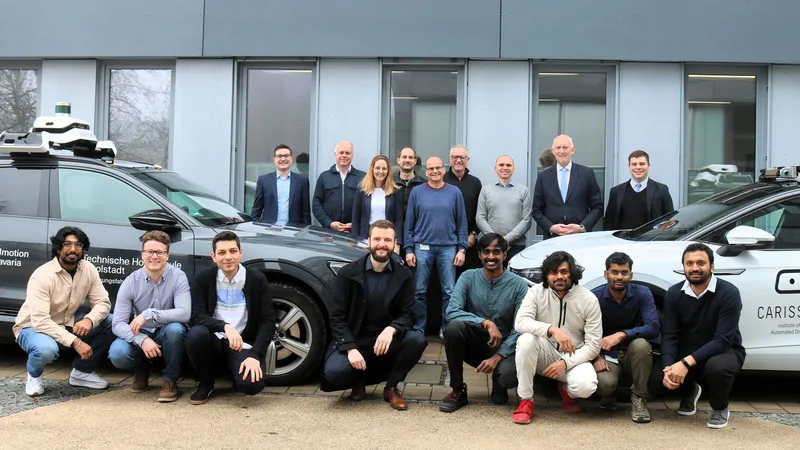
Combined expertise: The interdisciplinary research initiative team brings together specialists from diverse fields to achieve the best possible outcomes in vehicle safety (photo: THI).
![[Translate to English:] Logo Akkreditierungsrat: Systemakkreditiert](/fileadmin/_processed_/2/8/csm_AR-Siegel_Systemakkreditierung_bc4ea3377d.webp)