

A vehicle is travelling; the traffic is getting heavier. Suddenly, the car in front brakes abruptly. The system reacts immediately, the vehicle decelerates - but the impact can no longer be avoided. Within milliseconds, the situation changes fundamentally: the occupant's body moves forward, the upper body tilts, the head accelerates, and the position in the seat shifts. This brief moment determines how much strain is placed on individual parts of the body - and therefore how serious any injuries will be. The deployment and intensity of the airbag and seatbelt are of central importance. Up to now, safety systems have primarily been oriented towards the accident itself. How a person sits in the vehicle or what individual physical conditions they have is only taken into account to a limited extent. This is where the "AI-SAFe" project comes in: For the first time, it links the recording of occupant characteristics - such as posture, position, or individual characteristics - with the prediction of accident progression and severity. In addition, models are used to estimate the forces acting on the body and how injuries occur. On this basis, protection systems can be specifically controlled - for example, through optimised triggering times or differentiated intensities of airbag and seatbelt. AI-SAFe thus brings together several previously separate approaches: Occupant sensing, predictive accident analysis, Biomechanics modelling, and adaptive restraint systems. "Our focus is on the safety and vulnerability of people. If we consider occupant characteristics, accident progression, and injury mechanisms together, we can trigger protection systems adapted to the person and the accident situation," emphasises Professor Thomas Brandmeier, Scientific Director of CARISSMA-ISAFE. In addition to the THI, Audi, Autoliv, Aumovio, ANavS, the Ludwig Maximilian University of Munich (LMU), and Ingolstadt Hospital are involved in the project. The kick-off event brought together 27 experts from industry and science to launch the collaboration within the consortium. |
AI-SAFe: Research project develops adaptive safety safety systems for vehicles
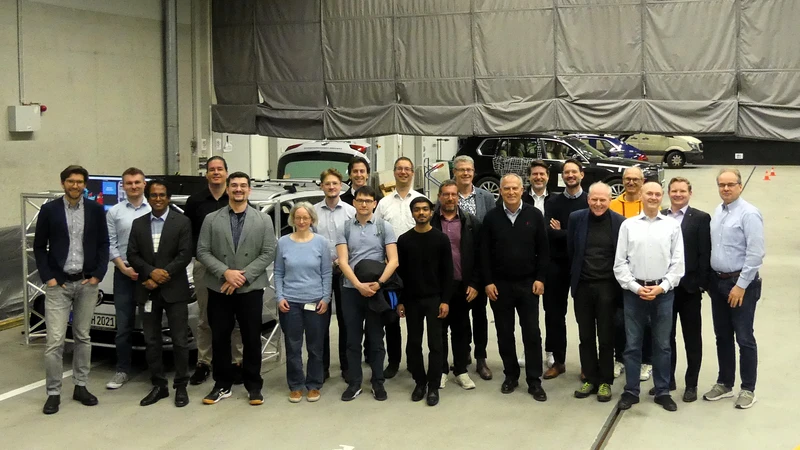
Kick-off of the research project “AI-SAFe” at THI: Project team and partners launch joint work on adaptive restraint systems for automated driving (Photo: THI).
![[Translate to English:] Logo Akkreditierungsrat: Systemakkreditiert](/fileadmin/_processed_/2/8/csm_AR-Siegel_Systemakkreditierung_bc4ea3377d.webp)