

Batteries are a central component of Electromobility and the energy transition. Until now, however, it has hardly been possible to fully trace their path from production to recycling. Dr Rufino has therefore developed a platform that digitally tracks every battery - from raw material extraction and use in the vehicle through to secondary use and recycling. This is based on blockchain technology, which securely stores all information and makes it transparently available. The system creates trust between all parties involved - from manufacturers and producers to end users and recyclers. End-to-end traceability makes it possible to check quality, safety, and sustainability in a targeted manner. At the same time, the solution opens up new perspectives for the circular economy: batteries can be used for longer, maintained more efficiently, and recycled more effectively at the end of their life cycle. Marianne Mang, President of the Rotary Club of Ingolstadt, emphasised at the award ceremony: "For the Rotary Club of Ingolstadt, promoting research and science is a conscious commitment to a future worth living. The Rotary Research Award 2025, therefore, recognises the combination of academic excellence and practical relevance of Dr Carlos Rufino Júnior's award-winning work on the digital passport for batteries." Dr Carlos Rufino Júnior completed his doctorate in Bioenergy at the University of Campinas (UNICAMP), Brazil, in cooperation with Prof Dr Hans-Georg Schweiger (THI). His dissertation was dedicated to the development of a blockchain-based platform for tracking batteries. He previously completed study courses in Systems and Automation Engineering (UFLA), Blockchain Applications (IGTI), Teaching in Higher Education (FUNIP), and Electrical Engineering (IFMG). His research is also highly regarded internationally. More than 20 specialist publications and over 290 citations emphasise the relevance of his work in his field. In his laudatory speech, IFG Executive Board member Professor Dr Georg Rosenfeld paid tribute to the award winner, saying: "Dr Rufino's work is an outstanding example of how research can create concrete solutions for the major challenges of our time. With the digital battery passport, he combines technological innovation with social responsibility - and thus makes a decisive contribution to a sustainable and transparent energy transition." Dr Rufino then presented his work in a short lecture and showed how scientific innovations can contribute directly to shaping a sustainable future. The Rotary Club of Ingolstadt has been awarding the research prize alternately to scientists from Technische Hochschule Ingolstadt and the Catholic University of Eichstätt-Ingolstadt since 2021. The award recognises work that uses new approaches to provide impetus for social, technical, economic, or ecological developments. |
A digital passport for batteries: Rotary Prize for Dr. Carlos Rufino Júnior
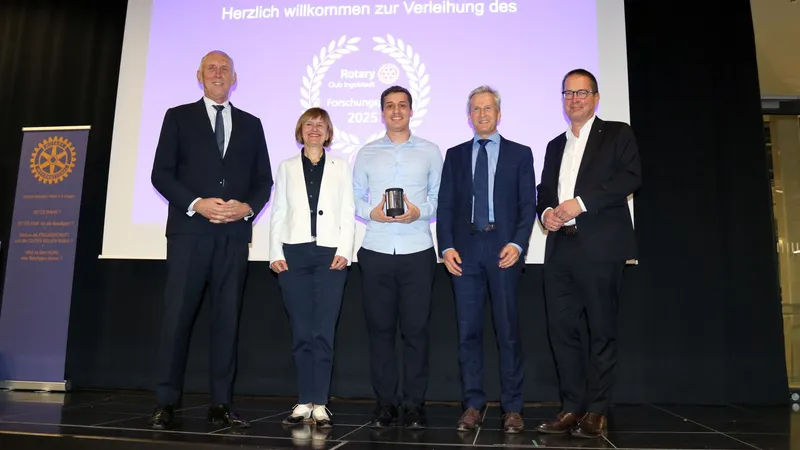
Together for innovation: THI President Professor Walter Schober, Rotary President Marianne Mang, award winner Dr Carlos Rufino Júnior, Chair of the Rotary Scholarship Ingolstadt Association Dr Martin Beck, and laudator Professor Georg Rosenfeld (photo: THI).
![[Translate to English:] Logo Akkreditierungsrat: Systemakkreditiert](/fileadmin/_processed_/2/8/csm_AR-Siegel_Systemakkreditierung_bc4ea3377d.webp)