

The project focused on a central topic of modern mobility: in the future, vehicle safety must not only react at the moment of impact, but must recognise impending collisions in advance. Today's systems reach their limits when it comes to particularly serious accidents, such as driving under a lorry trailer or colliding with a tree. Conventional crash sensors generally only recognise an accident after contact has been made. Even assistance systems have so far only provided limited usable information for restraint systems, as they rely on object classification and usually only provide rough dimensions of the recognised objects. This is precisely where KICSAFe came in: The project aimed to detect critical situations much earlier and more robustly in order to gain valuable milliseconds for the activation of protective systems such as airbags and seatbelt tensioners. This is particularly relevant for automated vehicles and future interior concepts in which occupants sit differently than today, and new restraint strategies are required. Although radar sensors provide robust measurements even in rain or fog, they can only capture the geometry of a lorry or a tree to a limited extent. Camera sensors close this gap. The project developed AI methods for environment perception and obstacle detection that are based on pixel-based distance estimation from camera images and further processing steps for obstacle detection and tracking - without the need to classify individual objects beforehand. Based on this, an AI-based collision interpretation makes it possible to predict whether a collision will occur and what type of collision is to be expected. For this purpose, physical and AI-based methods were combined in order to estimate probable movements, unavoidability, time-to-collision, and possible crash characteristics at an early stage. Particular emphasis was placed on the safe and traceable use of AI, which can also be reliably safeguarded for safety-critical applications. A special focus was placed on complex three-dimensional accident constellations, which are often recognised by existing crash systems only with difficulty or at a late stage. The project investigated collisions with large vehicles such as lorries or trailers, some of whose concave structures cannot be reliably detected by current systems. The team therefore analysed how camera-based AI methods can also reliably interpret such three-dimensional obstacle structures in the pre-crash phase. To develop the algorithms, the consortium combined synthetically generated simulation data with real driving and sensor data. In this way, a sufficient number of rare or particularly critical scenarios could also be included in training and validation without having to generate them in real road traffic or elaborately recreate them in test facilities. The practicality of the approaches developed was impressively demonstrated at the end of the project. In the presence of the project partners BMW and Aumovio, as well as the project sponsor VDI/VDE, a challenging accident scenario with several moving road users was simulated on the C-ISAFE indoor test area. An underride collision with the rear of a lorry was detected in advance. A specially developed lorry soft crash target served as the collision object. During a further demonstration drive through Ingolstadt, those present were also able to experience the applicability of depth estimation and criticality assessment live in real road traffic. KICSAFe thus shows how AI methods can be used in safety-critical functions if they are embedded in a modular approach with physically verifiable interfaces for plausibility checks. The project results thus support an AI-supported technological leap in vehicle safety - towards integral systems that do not just react to a crash, but recognise and evaluate it in advance. The KICSAFe project was funded by the Bavarian State Ministry of Economic Affairs, Regional Development and Energy under the funding code DIK0461/01. |
Artificial Intelligence (AI) for greater vehicle safety: KICSAFe project shows new ways of crash detection
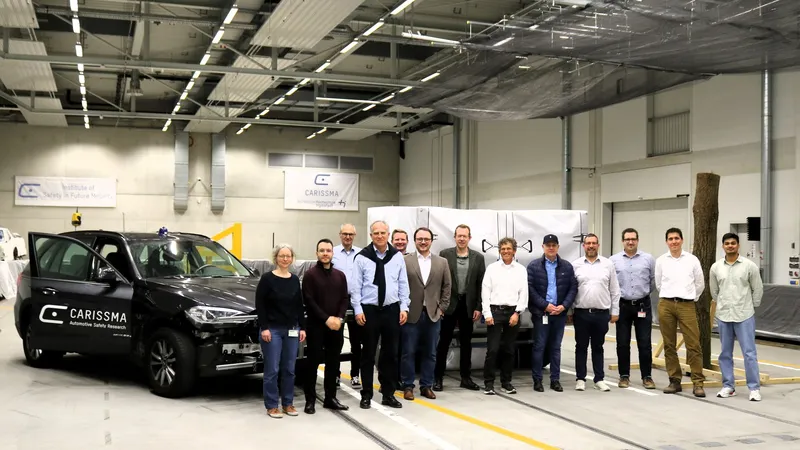
For the road safety of tomorrow: The KICSAFe team at the final demonstration (Photo: THI).

![[Translate to English:] Logo Akkreditierungsrat: Systemakkreditiert](/fileadmin/_processed_/2/8/csm_AR-Siegel_Systemakkreditierung_bc4ea3377d.webp)