

The smell of freshly ground coffee fills the air at Café Reimanns on the THI campus. Students with laptops and cups move between the lecture theatre and the Library across the forecourt. Kevin Mayer sits at the window and looks out. For him, this place is closely associated with a time of intensive research. His academic journey began here. From 2014 to 2018, Mayer studied Aircraft and Vehicle Informatics at THI, followed by a Master's degree in Computer Science until 2020. Even during his academic studies, he developed a special interest in IT security - a topic that received much less attention back then than it does today. Professor Hans-Joachim Hof was the main influence on this direction. Mayer wrote his Bachelor's Thesis with him. "In my bachelor's degree, I focussed on how systems can be hacked," he recalls. "Professor Hof then focussed more on the other side: how to protect them." After a few years in the field, Mayer returned to the THI as a research associate. There he worked at the CARISSMA Institute of Electric, Connected, and Secure Mobility on the Cybersecurity of modern vehicles - a field of research that is becoming increasingly important with the increasing digitalisation of mobility. These issues ultimately led to his doctorate in Digital Forensics at Friedrich-Alexander-Universität Erlangen-Nürnberg (FAU). The collaboration between THI and FAU in this cooperative doctoral programme was supported by BayWiss. In addition to Professor Hans-Joachim Hof, Professor Felix Freiling (FAU) also played an important role as academic supervisor and initiator. In his dissertation "On the Effectiveness in Automotive Digital Forensics", Mayer investigated how digital traces from modern vehicles can be systematically analysed. Modern cars store a large amount of technical data - for example on system events, sensor values or communication processes. Vehicle forensics uses this information to understand what actually happened in the vehicle after an incident - such as an accident or a cyberattack. Similar to traditional forensics, digital data is analysed and linked together. Mayer's work shows how such data can be analysed in a structured way in order to reliably reconstruct safety-relevant events. She is thus making an important fundamental contribution to vehicle forensics. Scientific success followed early on: at the age of just 32, Mayer was offered a professorship in cyber security at Rosenheim University of Applied Sciences. For him, however, this is not so much a degree as the beginning of a new phase - with his own responsibility in research and teaching as well as the opportunity to further develop the topic of Cybersecurity. Looking back to Ingolstadt, he remains grateful for the formative years at the THI. Many of the ideas that influence his research today originated on campus - in dialogue with colleagues and in discussions with his academic mentors. The collaboration with Professor Hans-Joachim Hof and Professor Felix Freiling continues to this day. For Mayer, this connection shows how academic careers develop: through support, trust and shared curiosity. |
Professor at 32 - How Kevin Mayer has shaped a new field of research at THI
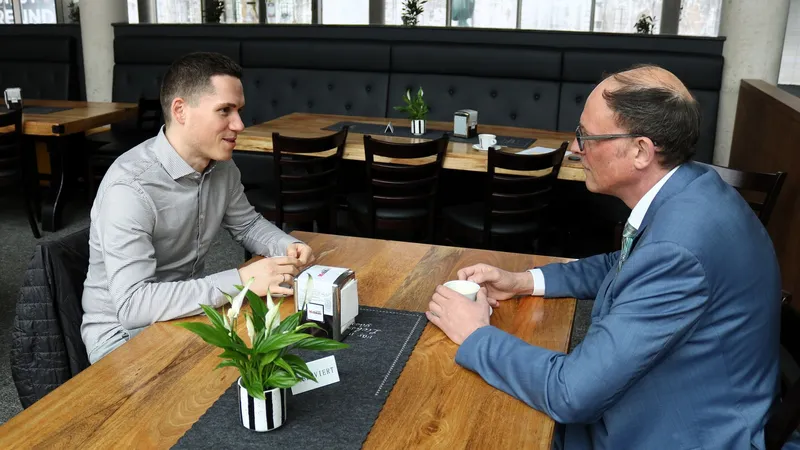
Kevin Mayer (left) and Hans-Joachim Hof on the campus of Technische Hochschule Ingolstadt: Mayer was Hof’s first bachelor’s student in Ingolstadt – today he is a professor himself (Photo: THI).
![[Translate to English:] Logo Akkreditierungsrat: Systemakkreditiert](/fileadmin/_processed_/2/8/csm_AR-Siegel_Systemakkreditierung_bc4ea3377d.webp)